


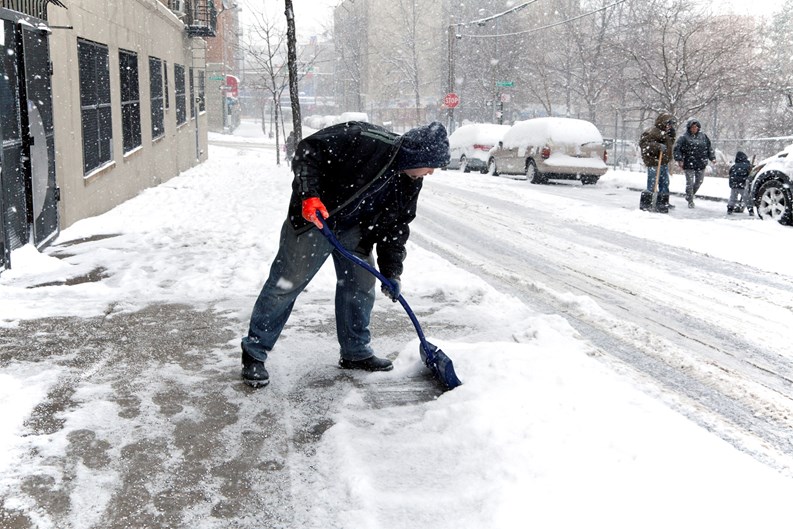
While climate change may have reduced the frequency of multi-foot snowfalls in the New York metro, when we do get dumped on, the precipitation tends to be heavier and icier than the fluffy drifts of decades past. With that shift comes concerns about the damage ice and water can cause to buildings through weight stress and leaks, as well as the risk to residents, staff, and passers-by from slip-and-falls on slick surfaces.
That’s why removing snow and ice from your steps, entry halls, and sidewalks as quickly and thoroughly as possible is so important; not just from a maintenance and upkeep perspective, but to keep people safe and reduce the risk of liability exposure.
“Snow removal isn’t something like construction or landscaping where there’s something concrete after you’ve paid,” says Martin Tirado, CEO of the Snow & Ice Management Association (SIMA), a Milwaukee-based non-profit trade group that represents the snow and ice removal industry, “but it’s still important because it helps you avoid slip and falls or an accident. Every year, there are fatalities due to winter weather, so to have that snow and ice managed with a professional company goes a long way toward justifying the expense.”
People tend to underestimate winter weather, Tirado continues—but it can be just as dangerous as any other kind of major storm. “Winter weather is unpredictable and [snow removal] is an emergency service,” he says. “When people are stuck, or they can’t get to school or work or out of their houses, that’s when emergency situations can arise. Our members take that very seriously, and try to perform professional services to get the snow and ice cleared. We need to be aware, though, that having bare pavement at all times is impossible, and we all need to be careful when walking or biking.”
Snowing is Half the Battle
In a multifamily context, it’s extremely important for boards and managers to know what their responsibilities are when it comes to removing snow and ice on their properties, and to make sure those responsibilities are clearly communicated to building staff and contractors.
First, it’s crucial to have clear protocols for dealing with ice and snow on your property. Whose task is it to physically go out and shovel, or sprinkle ice-melt on your paved surfaces? The superintendent? The porter? A board member? How often should he or she venture out to re-shovel or re-sprinkle? Does this person know where the property lines are? Do they have adequate tools and equipment to get the job done right, and do they know how to use them properly?
Next, your board, management, and relevant staff should understand local laws concerning what exactly it is you are responsible for when it comes to dealing with ice and snow, as well as the consequences for not meeting those obligations. Even if you’ve been managing properties or serving on your board for decades, the fact is that laws change all the time. So before the first flakes fall, it’s worthwhile to refamiliarize yourself with your local ordinances and rules concerning snow removal and liability.
“This sounds pretty basic—and it is—but property managers are generally required to keep their properties free of snow and ice on all walking surfaces that aren’t a city street,” says Noah VanKooten, board member and snow division manager for Chicago-based Christy Webber Landscapes.
Depending on the municipality, the snow removal options for associations, managers, and their staff could include a do-it-yourself approach wherein individual residents shovel their own driveways and sidewalks, having building staff do the grunt-work, or hiring a snow removal service on an as-needed or retainer basis. The costs for the third option can be divvied among residents as part of their regular monthly condo fees, just like any other maintenance cost.
Where Private Meets Public
While it is uncommon for private contractors and municipal snow removal teams to work together, it’s not entirely unheard of. If they do cooperate, it’s usually because of a shared interest—such as when a main road runs right through a condo community, or a condo development abuts a public space like a park or municipal building. However, according to the snow pros, their interests and that of city crews are often at odds. For example, a contractor could come through early in the morning, fulfill their contractual obligations and be on their way, only to be contacted later and informed that the city plows came through later, and dumped tons of snow where they plowed already. This happens often, and is sometimes complicated by the fact that some jurisdictions have fines for doing snow removal work outside the municipality’s set timetables.
As independent contractors, says VanKooten, “We are responsible generally for ‘creating a safe environment’ for all walking and driving surfaces at a given property; if we can’t prove that we have performed all of our contracted duties, we then basically become liable in a slip-and-fall. That doesn’t mean the area will never be slippery, or that a contractor or property manager is always at fault if someone slips, but there are various parameters built into our contracts that we abide by.”
Even if you think you know your responsibilities for snow removal, it’s always a good idea to check in on a municipal website before receiving a potentially costly citation. Many of the locality-specific requirements can be found on municipal informational websites like www1.nyc.gov for New York City, or mass.gov, which offers statewide regulations for Massachusetts, as well as a city and town list where you can find specific bylaws and ordinances for your building or association. Some more suburban townships also have noise ordinances that can limit the time you have to clear the snow or ice after the fall ceases to a very specific window.
The Iceman Cometh
Even though they’re both frozen water, snow and ice are different beasts when it comes to removal. For the latter, there are a number of different products that can be used, many of which are more environmentally friendly than old-fashioned rock salt.
“A lot of customers want calcium chloride instead of rock salt,” says Frank Schembre, president of Executive Snow Control in New York, adding that when it comes to de-icing liquids, “We don’t specifically use some of the liquids because we find some can be slippery, but most liquids work at lower temperatures than rock salt.”
“More service providers are being more aware and sophisticated with how much salt they are applying,” says Tirado. “A lot of times the answer isn’t just to keep applying rock salt because if it gets too cold, it can become ineffective. It can also kill vegetation come spring time and it’s environmentally harmful. Property owners should have a talk with their service provider about what the appropriate application is. The cost of salt has escalated, and the best way to ensure against the price fluctuations is to only use what’s needed to get the job done.”
He adds that one of the best ways to prevent damage to common areas is “to have some absorbent mats people can brush their shoes and boots on. Making sure to cover all the high traffic areas, the entrances and exits for example, is important.”
Watch Your Wallet
In addition to staying on the right side of the law, according to VanKooten, simply salting a walkway could mean the difference between an injury-free winter at your property versus a slip-and-fall accident that could result in hospitalization for the victim as well as thousands or even millions of dollars spent on legal fees and damages—all of which which could’ve been prevented with $20 worth of ice-melt.
It’s also important to remember that snow and ice are a threat to more than just bones and joints; both can cut deep into the money an association usually puts to the side for repairs. As it freezes, water expands in whatever space it finds itself in. When that space is a crack in a sidewalk or parking lot, it can cause damage to the concrete or asphalt, and result in expensive, disruptive repairs.
It’s About Planning
Be smart about managing snow and ice as there is more to it than just plows and rock salt; it’s also about planning ahead. Tom Canete, owner and CEO of Canete Landscape & Snow Management, a company based in Wayne, New Jersey that also offers snow removal services in Manhattan’s five boroughs and Westchester, advises property managers and boards to check in with their removal contractors before the first flakes fall.
The pros agree that boards and managers should start brainstorming towards the end of summer on how to prepare for getting rid of snow and ice. They also planned ahead. Schembre notes that it could take a few interviews before you find a contractor that works for you. “Something to look for when selecting a service provider is to make sure that they can meet whatever unusual demands the season produces.”
For those that have never had a provider before, Tirado suggests starting the search even earlier. “Those who are looking for a provider, but have never had one before, should start looking in the summer,” he says. “From the perspective of a provider it’s a combination of personnel needed, equipment needed, salt and other de-icing materials necessary to purchase in advance to have available to service their customers and if they aren’t already, their resources will essentially be sold out.”
And, he continues, “You should ask about their storm action plan. Make sure that yours is site-specific; and make sure there’s more than one plan, because no two storms are alike.” Canete also advises making sure the company you’re working with has the capacity and flexibility to handle weather events ranging from small accumulations to state-of-emergency 100-year blizzards.
Michael Mulholland, president of Montville, New Jersey-based landscaping company Advanced Land Management, agrees and adds that, “Once guidelines are set, the contract managers should trust that we are operating and making good decisions to keep the property safe. Ice management solutions are time-sensitive. That’s why with HOA properties, we try to come up with an all-inclusive contract that covers the association for snow and ice management [for a] predetermined cap [that is] often never reached. That way we can focus on doing the job the best way possible, rather than covering ourselves with paper trails during a storm. This takes a lot of stress off HOA boards and property managers because they know we’ll do whatever is needed to keep the property safe and accessible.”
Lastly, the pros stress the importance of being patient. You may be a paying customer, but you’re not the only customer. When a big storm hits, contractors often work around the clock to make sure everyone on their client list gets taken care of—but it’s not easy, and it takes time. All in all, with proper preparation, a clear game plan, and solid relationship with your removal contractor, you can ensure that your building or HOA is as safe and comfortable as possible when the snow starts falling.





Leave a Comment