


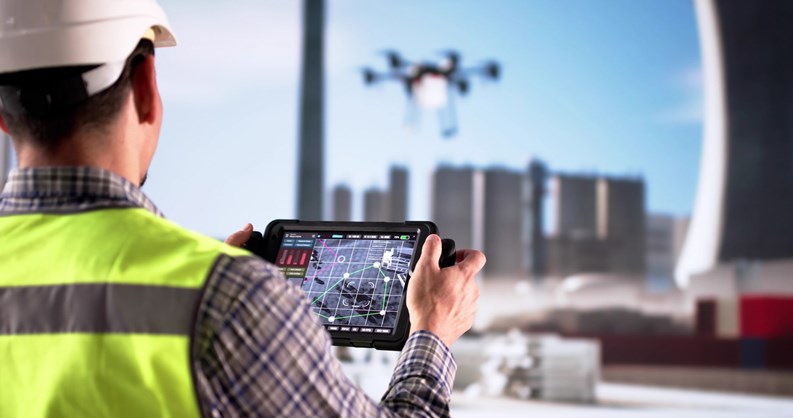
Drone technology is changing the way we do things in a wide array of fields, from moviemaking to weather reporting. In the real estate business, drones have quickly become indispensable—particularly when it comes to structural inspections, where they outperform human inspectors both in terms of productivity and of safety.
CooperatorNews recently spoke to Jonathan Ehrlich, CEO of T2D2, an AI building inspection company, and Gary P. Mancini, P.E., managing principal and renewal practice leader for Thornton Tomasetti, a structural engineering company, to get their insight on how drones and AI are changing the way building structures are inspected in NYC and beyond:
COOPERATORNEWS: What does drone technology bring to building inspections? How does it change them? Is there still a human element necessary?
GARY MANCINI: “New York City’s Façade Inspection and Safety Program (FISP), requires one hundred percent visual inspection, plus a certain amount of hands-on assessment. Drones can capture image data quickly and with a great deal of accuracy and resolution—far more than someone from the ground or a setback roof. So in terms of the visual portion of the FISP inspection, drones are a huge improvement over the current approach. However, as good as they are, drones are not a full substitute for a qualified person actually touching and sounding the façade. There’s a lot of information a human expert can process from this tactile interaction that a photographic image at any resolution simply cannot replicate. Using drones to supplement the visual inspections may allow us to reduce the degree of hands-on assessment, or at least provide information to help focus the hands-on assessment where it is most useful.”
CN: Can you tell us in layman's terms a little about the technology behind the drone use in building inspections?
JONATHAN EHRLICH: “Drones are now allowed to fly in NYC with a permitting process, which is overseen by the NYPD. Drone technology is improving rapidly, becoming easier, safer, and higher resolution. There are many commercially available drone platforms that are used for facade inspection. In addition to the hardware technology, there are software options that allow inspectors to easily review the footage, mark areas of damage for further inspection or repair, and create reports. This is an area where AI is advancing rapidly to help engineers and architects complete the process quickly.”
CN: How will drone use change the time frame and cost involved with building inspections—especially those required for compliance with LL97? What about other types of inspections?
MANCINI: “Drones will initially add some time and cost to the FISP inspection when compared to a traditional approach. Remember, right now an engineer can fulfill the one hundred percent visual just by walking around the building at sidewalk level. But a drone can provide far more robust and actionable data. And if used on a regular schedule, drone flights can begin to track façade conditions and identify problems or trends that need to be addressed proactively, before they worsen into conditions that are much more invasive and costly to repair. This approach can provide owners with accurate, date-stamped records of their facades that can then be used for planning purposes, or even to support an insurance claim or a warranty issue. It can be valuable to a building manager because it gives them the real time information on their façade conditions in between the mandated FISP cycles—akin to a building management system (BMS) that monitors mechanical and electrical systems. Of course, in the end, the benefit of having reliable and consistent information is acting on it by performing timely repairs and maintenance on the façade.”
CN: Can you provide us with a real life example?
EHRLICH: “A great example is at 345 Hudson Street in Manhattan. The owner was in the process of renovating the building, as well as building a new building next door, at 555 Greenwich Street. They wanted to complete their five-year FISP inspection all at the same time. They were able to take advantage of drone imagery as a part of this city-block capital project to make sure that no spot was missed, and to ensure that the 100-year-old building was restored to a condition that matched the brand-new adjacent building. The drone imagery and AI analysis was also used as a pre-condition survey to mark the condition of the existing building prior to the adjacent construction next door. This meant that as the owner progressed to the repair stage of the project, the data that could be shared with the contractors was much more precise than a set of architectural drawings with indicative conditions—resulting in a more accurate cost estimate.
“The building now has a baseline set of data against which it can compare future scans automatically, using AI change detection. This allows future inspections to take place in a fraction of the time, because of data that is already in place. This is truly the future of how all facades should be analyzed. Instead of spending weeks on a boom lift or swing stage scaffold, a drone can fly the building and results can be compared instantly.”
CN: How widespread is drone use in inspections now? At what rate will it accelerate?
EHRLICH: “We estimate that over 30 percent of engineers and architects who perform facade inspections are using drones as a tool in that process. There are other cities around the world, such as Singapore for example, where drone use is as high as 80 percent or more. We expect usage in New York City to increase. Practitioners are recognizing how useful this tool is, and building owners are realizing the power of more data leading to more precise cost estimates and fewer cost overruns.”
CN: Is there any area where drone use for inspections is less reliable than conventional inspections done by human inspectors? If so, how is that checked and compensated for?
MANCINI: “Again, from the standpoint of capturing useful photographic images, drones are far superior to what a human inspector can possibly accomplish from the ground with binoculars. In addition, there are now AI tools that have been trained using computer vision, and can be used to scan hundreds or thousands of image files to identify visible anomalies with essentially the same reliability as humans, and more rapidly. The human inspector’s role would be to confirm and validate the AI findings.”
EHRLICH: “From the visual perspective, drones are as accurate, if not more accurate, than a human inspector. Many people don't realize that FISP requires a human inspector to visually look at one hundred percent of the building, which means sometimes using binoculars from the sidewalk, even if the building is over 50 stories tall. It’s well known that this method is not effective. A drone allows inspectors to get visual imagery as if they were standing six inches away from every single part of the facade—something that was impossible before.
“Nevertheless, it’s generally agreed that there’s a benefit to physically touching and feeling the facade for loose materials, and in some cases tapping materials with a mallet to determine stability based on sound characteristics. Right now, that can't be done with a drone. Still, we believe that the vast majority of conditions of concern have a visual cue that can be caught by a drone, then followed up on in-person if needed. We’re working on studies to determine exactly what percentage of cases that is.
“We also differentiate drone inspections reviewed by a human versus drone inspections reviewed by AI + human, never by AI alone. AI is a great co-pilot technology that can walk a human inspector through the results to make sure they do not miss a spot. DOB put out a technical bulletin in 2021 addressing this and encouraging inspectors to embrace AI to make their workflows more comprehensive and efficient.”
CN: That was fascinating—thanks so much for joining us.
EHRLICH & MANCINI: “Thanks for having us. Happy Holidays!”






2 Comments
Leave a Comment